
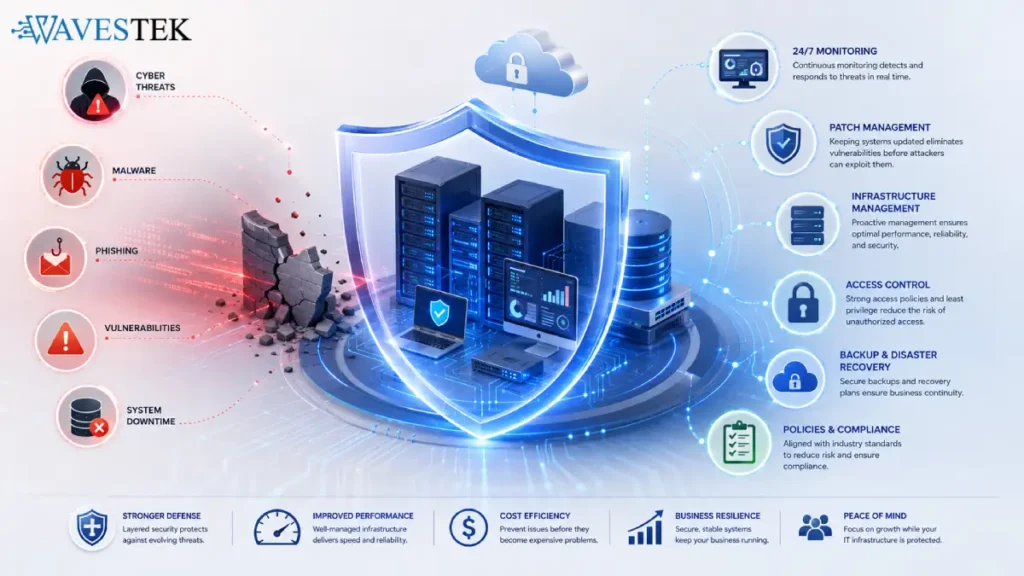
When most business owners think about defending their company from digital threats, they immediately think of tools like password managers, complex encryption software, or phishing response filters. These are vital defenses. However, trying to deploy advanced security tools on top of an unstable, unmanaged network is a major operational risk. It’s the equivalent of putting an elite lock on a door with rusted hinges.
True corporate defense requires a much stronger baseline. Strategic business cybersecurity solutions rely entirely on the quality of the network beneath them.
When your hardware, servers, and configurations are handled systematically, your day-to-day operations become inherently resilient. Whether your team operates from a corporate space in Manhattan, a tech firm in Brooklyn, or a logistics center in Queens, structured IT infrastructure management serves as your ultimate defense layer against modern digital threats.
To stay updated on the latest security protocols, infrastructure advice, and tri-state technology updates, explore the Wavestek Blog | IT Insights, Cybersecurity & Cloud Solutions NYC.
1. Closing Vulnerabilities Through Automated Patching
Outdated application versions and forgotten server updates are open invitations for malicious actors. Exploiting unpatched, legacy systems remains one of the primary methods hackers use to infiltrate company networks.
Dedicated infrastructure management removes human error from this equation by introducing centralized patch deployment. Rather than relying on staff members to update their own devices, your operating systems and local hardware are updated behind the scenes. This proactive step systematically seals entry points before threats can exploit them, which is critical for protecting hybrid workforces handling assets from Long Island City, Astoria, or Flushing.
2. Eliminating Security Blind Spots via Fleet Visibility
You cannot secure an asset you do not know exists. As hybrid work models expand across regions like Williamsburg and Hoboken, employees frequently connect unverified personal tablets, smart devices, or unauthorized cloud applications to corporate servers. This behavior creates untracked, vulnerable access points.
Structured management architecture continuously scans and maps your entire digital footprint. By providing full visibility over every workstation, server, and connected endpoint, your IT team can enforce uniform security protocols. If a non-compliant or compromised machine attempts to log in, it is flagged and handled immediately.
3. Minimizing Risk with Strategic Network Segmentation
If your corporate network functions as one massive, open digital space, an intruder who breaches a single weak link—such as a smart printer or a remote laptop—can move horizontally across your environment to access payroll or client databases.
Infrastructure engineering addresses this exposure by splitting your architecture into isolated segments. Keeping your guest Wi-Fi, internal communications, financial transactions, and client portals completely separate drastically minimizes the blast radius of a breach. This structured defense ensures that an incident in a regional hub like Jersey City or Newark is contained before it impacts your core operations.
4. Reducing Human Error with Uniform System Building
Misconfigured settings, particularly within complex cloud setups, are a leading cause of accidental data exposure. When servers or databases are built manually or altered on the fly, small variations naturally introduce significant security flaws.
Comprehensive infrastructure management relies on standardized, automated configurations. Deploying servers and cloud spaces from uniform, pre-hardened templates remove manual guesswork. This approach ensures your systems stay secure over time across all expanding business locations, whether in Yonkers, White Plains, Garden City, or Hempstead.
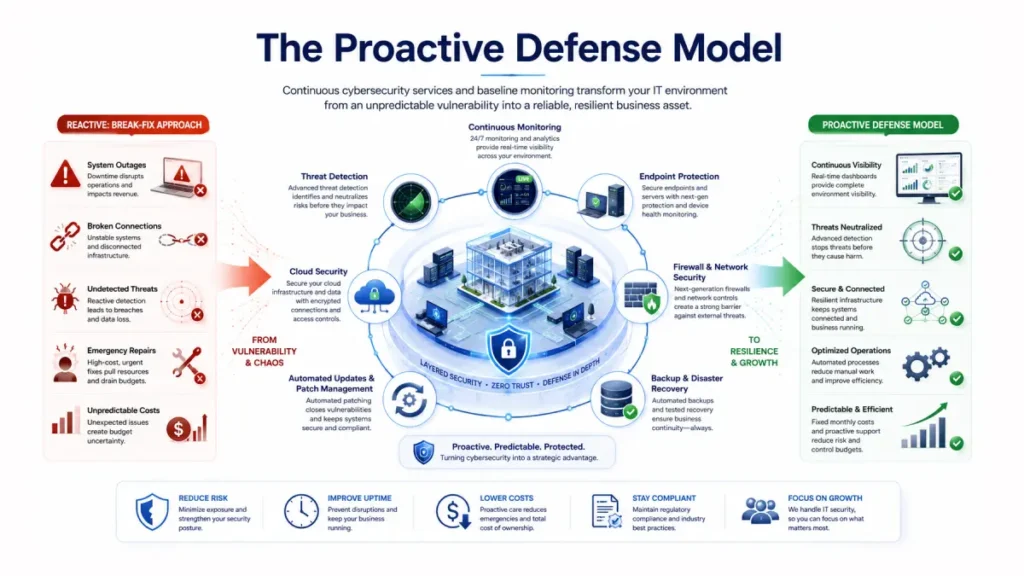
The Proactive Defense Model
Shifting away from a reactive “break-fix” approach is the most impactful decision you can make for your company’s protection. By combining day-to-day cybersecurity services with continuous baseline monitoring, your technical environment transitions from unpredictable vulnerability into a reliable, resilient business asset.
5. Spotting Intrusions via Structural Anomaly Detection
Advanced modern threats are designed to slip into systems silently, quietly gathering intelligence or staging data for weeks before launching a visible attack. Detecting these threats requires a clear understanding of what normal operational traffic looks like.
Infrastructure tools track your data flow around the clock. When a clear operational baseline is established, system engineers can instantly spot sudden, unusual patterns—like an unexplained bulk data download at midnight or a sudden spike in resource usage on a server. Catching these structural anomalies early allows teams to isolate and neutralize threats before damage occurs.
Conclusion: Security Starts at the Foundation
Cybersecurity is not an isolated software layer you can purchase and forget about; it is the natural byproduct of a stable, well-maintained network environment. Investing in enterprise-grade cybersecurity solutions for small business protects your revenue, shields your brand’s reputation, and preserves consumer trust.
When your digital backend is properly managed, your company gains more than just technical stability—it achieves a secure foundation built for long-term growth.
Build a Highly Secure, Resilient Digital Infrastructure
Stop letting un-managed technical setups create unnecessary risks for your business. Secure your network with 24/7 proactive monitoring, advanced threat defense, and local support designed to keep your team operational across Fort Lee, Bayonne, and the surrounding tri-state area.