
Cybercriminals aren’t spending weeks trying to crack complex network firewalls anymore. Instead, they use automated bots to guess weak employee passwords, deploy convincing AI deepfakes, or hunt down minor software bugs you forgot about.
For businesses running fast-paced operations across Manhattan, Brooklyn, and Queens, a single security oversight can cause total chaos. We’re talking about massive revenue hits, legal penalties, and losing customer trust in seconds. Relying on a slow, reactive IT team just doesn’t work anymore.
Building a successful data breach prevention strategy means moving past basic threat management. You need a system that actively blocks intrusions. Whether your staff is down in Long Island City, working out of a Newark hub, or managing operations from Jersey City, learning how to protect business data from hackers starts with a hardened digital perimeter.
To track real-time threat updates, compliance rule shifts, and local tech tactics, check out the Wavestek Blog | IT Insights, Cybersecurity & Cloud Solutions NYC.
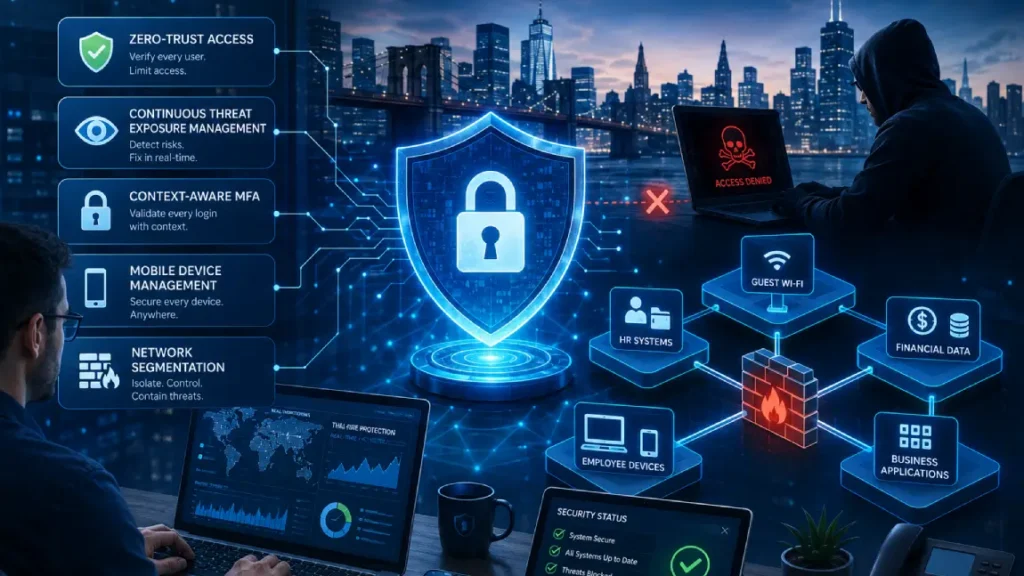
1. Ditch Legacy VPNs for Zero-Trust Access
Old-school VPN’s make a massive security flaw. Once an employee logs into a standard VPN, they have the keys to the kingdom. If a hacker steals that login, they can move sideways through your files completely unnoticed
Zero-Trust Network Access changes that. It treats every single connection request as a potential threat until proven otherwise. Access is checked constantly based on device health, user behavior, and strict role permissions.
This means if a hybrid team member logs into corporate apps from Astoria, Flushing, or Hoboken, they can only see the exact tools they need for their job. The rest of your data stays completely invisible to them.
2. Implement Continuous Threat Exposure Management (CTEM)
Waiting around for an annual security checkup to find holes in your system is an open invitation for an attack. Automated AI hacking tools scan networks constantly, looking for unpatched software, old test portals, or weak cloud links.
Bringing in professional cybersecurity services that use continuous exposure management fixes this. This framework runs automated sweeps across your entire setup, covering remote offices in Williamsburg, White Plains, or Yonkers.
Your technical team spots vulnerabilities in real time and patches them before an intruder even knows they are there.
3. Lock Down Logins with Context-Aware MFA
Stolen or weak passwords are still the easiest way for hackers to break into a business. Standard passwords stand zero chance against modern brute-force cracking tools.
You need MFA turned on for every app, cloud drive, and third-party login your team uses.
Take it a step further by using context-aware MFA. If a user tries to log in using valid credentials, but the system notices the request is coming from a weird location or an unrecognized laptop, it automatically blocks the session. This keeps your sensitive files safe even if a password leaks.
4. Run Centralized Mobile Device Management (MDM)
Hybrid work schedules mean your company data constantly lives on phones, tablets, and remote laptops. If an unmanaged device gets stolen or hooks up to a bad public Wi-Fi network, your core databases are completely exposed.
An MDM platform lets your IT team manage and secure every device from a single dashboard. Whether your employees are working on-site in Garden City, Hempstead, or Fort Lee, their hardware stays fully encrypted. If a phone goes missing, you can wipe all corporate data from it remotely.
The Reality Check: You can’t just buy one piece of software and call it a day. Real data security happens when you combine identity checks, smart network layouts, and constant monitoring into a single, daily routine.
5. Use Network Segmentation to Trap Intruders
When your network is one giant digital room, a breach on an office printer or a front-desk computer gives an attacker free rein to look at payroll or executive emails.
Network segmentation acts like internal fire doors. It isolates different parts of your business from each other. By separating your guest Wi-Fi, HR tools, financial records, and daily workflows, you shrink the danger zone.
If someone compromises on a device at a facility in Bayonne or an office in Manhattan, the threat gets trapped right there. Your defense team can isolate the problem before it ever touches your primary servers.
Conclusion: Build a Highly Resilient Operation
Protecting your business from hackers isn’t an IT chore; it’s basic risk management. Investing in comprehensive business cybersecurity solutions keeps your revenue safe, insulates you from massive legal liabilities, and protects the consumer trust you’ve worked hard to build.
Get your data defense handled proactively, and you’ll build a stable foundation ready for long-term growth.
Stop Leaving Your Data Vulnerable to Hackers
Don’t wait for a data breach to show you where your security gaps are. Protect your enterprise with 24/7 predictive threat monitoring, smart identity controls, and local engineering built for tri-state businesses.
Contact Wavestek today to get a professional vulnerability assessment and swap out your network liabilities for real, enterprise-grade protection.